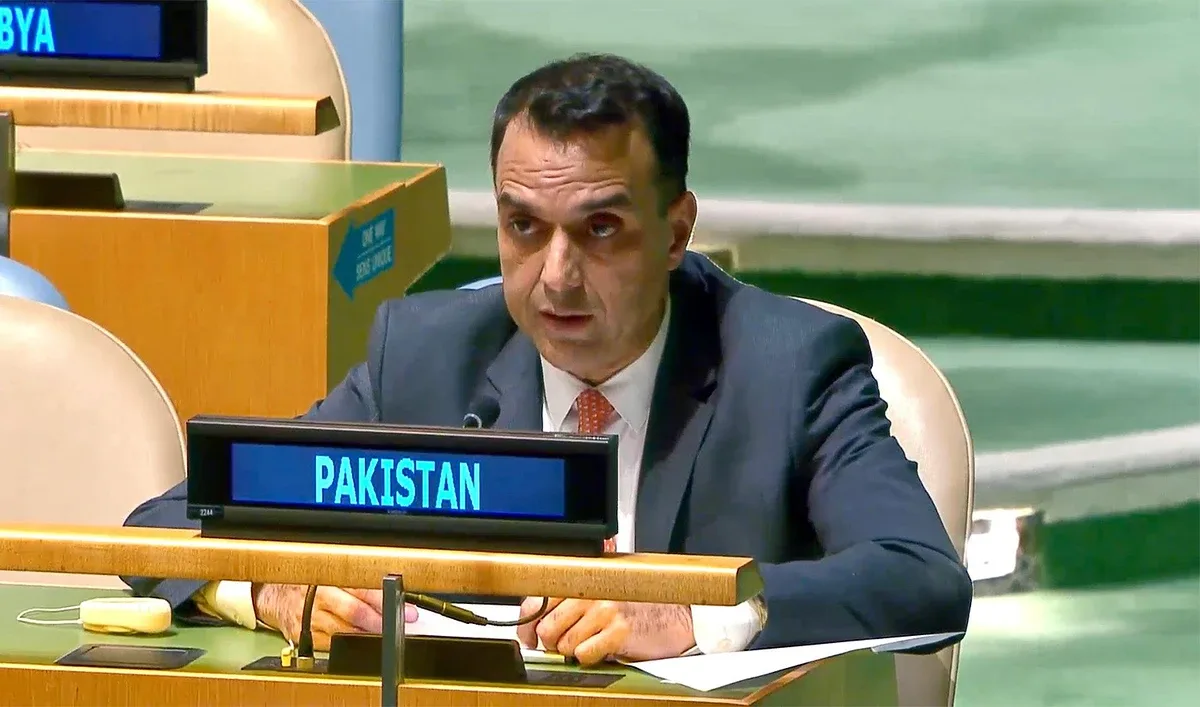
NEW YORK: Pakistan has strongly rejected India's unilateral decision to place the Indus Waters Treaty in abeyance and threats to restrict the flow of rivers into Pakistan, warning that using shared natural resources as a political weapon violates international law and threatens the livelihoods and well-being of more than 240 million people.
Addressing an Arria-formula meeting of the United Nations Security Council titled Natural Resources and Conflict: Promoting Cooperation for Prevention and Peace, organized by Liberia, Pakistan's Deputy Permanent Representative to the UN, Ambassador Usman Jadoon, emphasized the importance of international cooperation in managing shared natural resources.
Ambassador Jadoon said that the Permanent Court of Arbitration, in its August 31, 2026 ruling, reaffirmed that the Indus Waters Treaty remains fully in force and that India is obligated to comply with its commitments under the agreement.
He stressed that no country should be allowed to use shared natural resources as a means of political pressure or coercion in violation of international law and treaty obligations.
Referring to UN Security Council Resolution 2788, Ambassador Jadoon highlighted the importance of peaceful dispute resolution under Article 33 of the UN Charter, particularly in addressing disputes involving shared transboundary natural resources, including water.
Emphasizing the relationship between natural resources and conflicts, he said these resources should serve as instruments of sustainable development, shared prosperity and peace rather than exploitation and confrontation.
The Pakistani diplomat also reaffirmed Pakistan's solidarity with African countries in their efforts to exercise sovereign control over their natural resources.
He observed that external interference, illegal exploitation of resources, political exclusion, weak institutions and the concentration of resource wealth in the hands of elites often turn natural resources into sources of conflict.
Citing the Democratic Republic of the Congo as an example, he noted that despite its vast mineral wealth, the country continues to face conflicts instead of translating its natural resources into widespread public prosperity.
Ambassador Jadoon outlined three key priorities for preventing conflicts linked to natural resources.
First, he called for addressing the underlying political and governance-related causes of conflicts through inclusive political reconciliation and equitable distribution of resources.
Second, he emphasized the need for greater transparency across supply chains, responsible sourcing and international cooperation to prevent the illegal movement of resources and the financing of conflicts.
Third, he stressed the importance of ensuring that developing resource-rich countries benefit from investment, local production and processing, technology transfer and value addition.
He further underlined that the management of natural resources must be guided by the UN Charter, international law and the principle of permanent sovereignty over natural resources, as recognized in UN General Assembly Resolution 1803.
Concluding his remarks, Ambassador Jadoon said the international community should work towards making natural resources a source of cooperation, shared prosperity and sustainable peace rather than exploitation, inequality and conflict.